
BlogSoFinance
xStocks multiplier explained: why one on-chain token is not always one share
How xStocks handle dividends and stock splits with a multiplier, why your Solana raw token balance stays the same, how to read per-share prices, and what it means for same-stock liquidity pools.
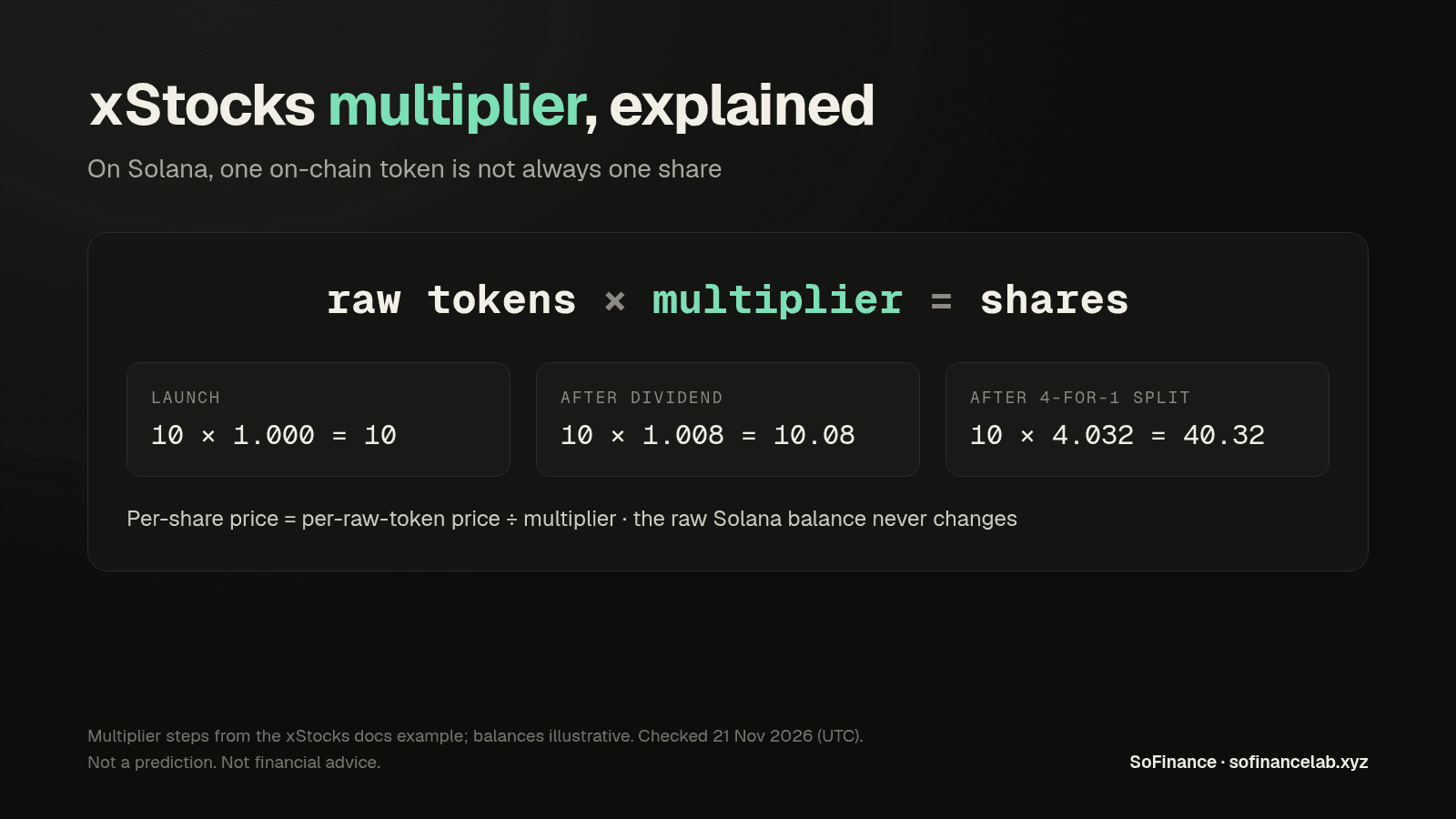
If your xStocks balance changed without a transfer, or a token price looks different from the stock price, the first thing to check is the multiplier. It is how xStocks account for dividends and stock splits. On Solana it changes what a raw token represents without changing the raw token count.
We explain the units, show an example, and cover what the multiplier means when you provide liquidity in a same-stock pool. We checked xStocks' own docs on 21 November 2026 (UTC).
Disclosure: we build SoFinance, a self-custodial tool for same-stock pools such as TSLA/TSLAx. We do not issue the tokens and are not affiliated with xStocks or its issuer.
Raw tokens, displayed shares and the multiplier
The xStocks docs say each xStock starts with a multiplier of 1.0: one token represents one share's value. Corporate actions then change the multiplier over the life of the token.
On Solana, the raw on-chain balance stays constant. A multiplier is stored in token metadata, and wallets apply it to show the share balance:
Displayed shares = raw token balance × multiplier
For example, if you hold 10 raw tokens and the multiplier is 1.008, the displayed balance is 10.08 shares. No transfer took place; each raw token now represents a little more of the underlying stock.
On EVM chains, the contract adjusts balances directly, so the standard balance call already returns the adjusted amount. Do not apply a Solana-style conversion to it again.
Dividends: reinvested, not paid as cash
According to xStocks, when the underlying company pays a dividend the custodian receives it and reinvests it into more shares of the same stock, net of applicable withholding taxes. The multiplier rises to reflect those extra shares.
The example in the xStocks docs uses a multiplier moving from 1.0 to 1.008. One raw token now represents 1.008 shares. There is no separate cash payment and no transfer adding raw tokens to your Solana account.
That is different from trading fees collected by an LP position. The dividend adjustment comes from the issuer and the underlying share; LP trading fees come from swaps through a pool. They are separate.
Stock splits and reverse splits
The same mechanism handles splits:
- 4-for-1 split: the multiplier is multiplied by four. The xStocks docs use 1.008 → 4.032. One raw token now represents 4.032 post-split shares.
- 2-for-1 reverse split: the multiplier is divided by two. The docs use 4.032 → 2.016.
A split does not create value by itself. The share count rises and the price per share falls proportionally. A display that shows the higher share count but keeps the old per-share price will look wildly wrong.
Per-token price vs per-share price
A price feed can quote either unit:
- Price per raw token: the value of one on-chain token before applying the multiplier.
- Price per share: the value of one displayed, equity-adjusted share.
To convert:
Per-share price = per-raw-token price ÷ multiplier
Per-raw-token price = per-share price × multiplier
Illustrative example, not a live quote: a raw token priced at $201.60 with a multiplier of 1.008 is priced at $200 per share. If an app divides that $200 again, it understates the price. If it multiplies a $201.60 raw-token quote again, it overstates the value.
The rule is simple: match amount units to price units. Raw token amount times raw token price, or displayed share amount times per-share price. They should give the same value.
Why this matters for same-stock pools
A same-stock pool pairs two versions of one stock, for example TSLAx / TSLA on Raydium or NVDAx / NVDA on Meteora. People often expect the pool price to be exactly 1. But if the issuers' raw tokens represent different numbers of shares, the fair raw-token ratio is not 1:1.
Suppose token A represents 1.008 shares and token B represents 1.000 share. Ignoring market premiums or discounts, one raw A should be worth about 1.008 raw B. A raw pool price near 1.008 would be fair, not a 0.8% arbitrage gap.
A tight LP range around 1.000 could therefore be wrong even though both tokens track the same stock. When a multiplier changes, the fair ratio can move and a previously good range can become out of range. This is one reason to check the units and corporate actions before opening a very tight range.
What to check before you sign
- Confirm the mint and chain. A ticker alone is not enough to identify a token.
- Read the effective multiplier. xStocks says current and historical values are available through its Assets endpoints; the token metadata is the on-chain source on Solana.
- Check what the UI displays. Is the amount raw tokens or shares? Is the price per raw token or per share?
- Look at corporate actions. A dividend or split can explain a sudden multiplier change. The issuer's terms, not a DEX label, define the token's economics.
- Review the LP range in the pool's price units. A range around a raw ratio is not necessarily a range around 1:1 shares.
The xStocks docs say multiplier activation is at 00:30 UTC on the day after the corporate action's ex-date and advise venues to pause interactions briefly around activation. Check the current issuer schedule rather than assuming every app has applied an update at the same time.
What the multiplier does not solve
It accounts for corporate actions; it does not make the token identical to a brokerage share or remove issuer, eligibility, smart contract or price risk. Two issuers can still trade at a premium or discount after you account for units, and an LP position can still have impermanent loss.
If you want to see the same-stock pools we support, start at the pools page. If you are new to the setup, read What is a same-stock LP pool? first.
FAQ
What is the xStocks multiplier?
The multiplier is the ratio between an xStock's raw on-chain token amount and the shares it represents. It starts at 1.0 and changes when the underlying stock pays a dividend, splits or does a reverse split. On Solana, the raw balance stays fixed and the displayed share balance is raw balance times multiplier.
Do xStocks pay dividends?
Not as cash. The issuer reinvests dividends into more of the underlying share, net of applicable withholding taxes, and raises the multiplier. The displayed share balance increases even though the raw token balance on Solana stays the same.
Why did my xStocks balance change without a transfer?
A corporate action may have changed the multiplier. On Solana the raw token amount does not change; a wallet that applies the multiplier shows the updated share amount. Check the issuer's multiplier data and the underlying stock's corporate actions.
How do I convert a token price to a per-share price?
If a quoted price is per raw token, divide it by the multiplier to get a per-share price. If it is already a per-share price, do not divide again. Mixing raw and scaled amounts is a common source of wrong-looking prices.
Does a stock split make my xStocks worth more?
No. A split increases the number of shares represented and reduces the price per share proportionally, so the total value is unchanged by the split itself. The multiplier tracks the new share count.
Why is a same-stock pool not always priced at exactly 1:1?
If the two issuers have different multipliers, one raw token can represent more shares than the other, so the fair raw-token ratio is not 1:1. Small market premiums and discounts can move it further. Compare prices in the same units before calling a gap an opportunity.
What should LPs watch around a multiplier update?
The fair ratio between two issuers can shift, and a tight same-stock range can go out of range. xStocks advises venues to pause interactions briefly around activation. Check the issuer's schedule and review your range; do not assume a price gap is just market demand.
Sources
- xStocks docs, Dividends and Stock Splits and xStocks for Developers
- Kraken support, xStocks Frequently Asked Questions, updated 11 November 2026
- SoFinance, What is a same-stock LP pool? and Risks
Docs checked on 21 November 2026 (UTC). Examples illustrate units, not current prices or future performance. Not a prediction. Not financial advice. Liquidity providing can lose money. Fees not guaranteed.